How to Tell If a Split Tree Trunk is Stable Enough to Remain Standing
A split tree trunk can stop you in your tracks. Maybe a recent storm rolled through your Long Island neighborhood and left one of your backyard trees with a dramatic crack running down its center. Maybe you noticed the split gradually over time and kept telling yourself you would deal with it later. Either way, you are now standing in your yard staring at a damaged tree and asking yourself the same question that homeowners across Suffolk County ask every fall season: is this tree still safe, or does it need to come down?
The honest answer is that it depends on a range of factors, and not all split trunks are created equal. Some trees with splits have been standing for decades and pose very little immediate risk. Others look relatively minor on the surface but are hiding serious structural failure that could send a heavy limb or entire trunk crashing down onto a fence, a roof, a car, or worse. Knowing how to evaluate what you are looking at is not just a matter of curiosity. During fall, when storms become more frequent on Long Island and deciduous trees shed their leaves, the structural condition of your trees becomes especially important. Wet soil, high winds, and the added stress of seasonal transitions can push an already compromised tree over the edge.
This guide will walk you through the key indicators that tree care professionals use to assess whether a split trunk is stable enough to remain standing, and when it is time to stop guessing and call in an expert.
Understanding What Causes a Tree Trunk to Split
Before you can accurately assess whether a split trunk is stable, it helps to understand what caused the split in the first place. Tree trunks split for several different reasons, and the cause often tells you something important about the severity and the prognosis for the tree going forward.
One of the most common causes is lightning. When lightning strikes a tree, the rapid heating of internal moisture can cause the wood to essentially explode from the inside out, creating long vertical splits that run down the trunk. Lightning strikes are often more destructive than they appear because the internal damage can extend far beyond what is visible on the surface.
Storm winds are another major cause, particularly on Long Island where nor'easters and coastal storms bring sustained gusts that place enormous lateral stress on tree trunks. When a tree is rocked back and forth repeatedly, weak points in the wood or root system can give way, resulting in a split or crack. Ice storms create similar problems by adding tremendous weight to branches and canopies, which then transfers stress downward into the trunk.
Co-dominant stems are a structural issue that develops over time rather than through a single event. When a tree grows two or more main stems of roughly equal size, those stems often form a tight V-shaped union rather than a strong U-shaped one. Over the years, bark can become included between the stems, which prevents the wood from fusing properly and creates a naturally weak attachment point that is prone to splitting. This type of split is especially common in ornamental trees and certain hardwood species found throughout Long Island neighborhoods.
Finally, decay and disease can hollow out sections of a trunk from the inside, leaving the outer layers of wood to hold up the tree without adequate support. When this internal weakness reaches a certain point, the remaining wood can crack or split under ordinary stress.
Visual Signs That a Split Trunk May Still Be Structurally Sound
Not every split trunk signals immediate disaster. There are certain characteristics that suggest a tree may still have enough structural integrity to remain standing, at least in the short term.
One positive sign is a split that is shallow and does not penetrate deeply into the heartwood of the tree. If you can see that the crack is primarily in the outer bark and cambium layer rather than extending into the core of the trunk, the structural impact may be limited. These types of superficial splits are sometimes called bark inclusions or surface checks, and while they still warrant monitoring, they do not necessarily indicate imminent failure.
The shape of the split also matters. A horizontal crack or one that runs at a diagonal angle across the trunk is generally considered more serious than a vertical crack. Vertical splits often follow the natural grain of the wood, while horizontal cracks cut across the grain and can more directly undermine the tree's ability to support weight from above.
Another factor to consider is whether the split appears to be old or new. An older split will often show signs of callus growth around the edges, which is the tree's natural response to wounding. Callus tissue is a thickened, rounded growth of new wood that forms at wound margins over time. If you see well-developed callus tissue surrounding a crack, it suggests the tree has been living with the split for some time and has been actively trying to compartmentalize the damage. This does not mean the tree is fully safe, but it does indicate the split is not a sudden new failure.
Signs that may suggest more stability include:
- Visible callus or woundwood growth along the edges of the crack
- A split that is confined to one side of the trunk rather than traveling all the way through
- No signs of fungal fruiting bodies, mushrooms, or conks near the base or along the trunk
- A healthy, full canopy with no significant dieback on the side of the tree affected by the split
- A trunk that remains upright without leaning toward any structure or high-traffic area
- No visible root damage, heaving soil, or exposed roots on the side the tree is leaning toward
Even if several of these positive indicators are present, they do not guarantee safety. A visual inspection from the ground has real limitations, and what looks stable from the outside can be quite different once an arborist takes a closer look.
Red Flags That Indicate a Split Trunk Is Too Dangerous to Leave Standing
There are also clear warning signs that a split trunk has crossed into dangerous territory and that removal or emergency intervention is likely the only responsible course of action.
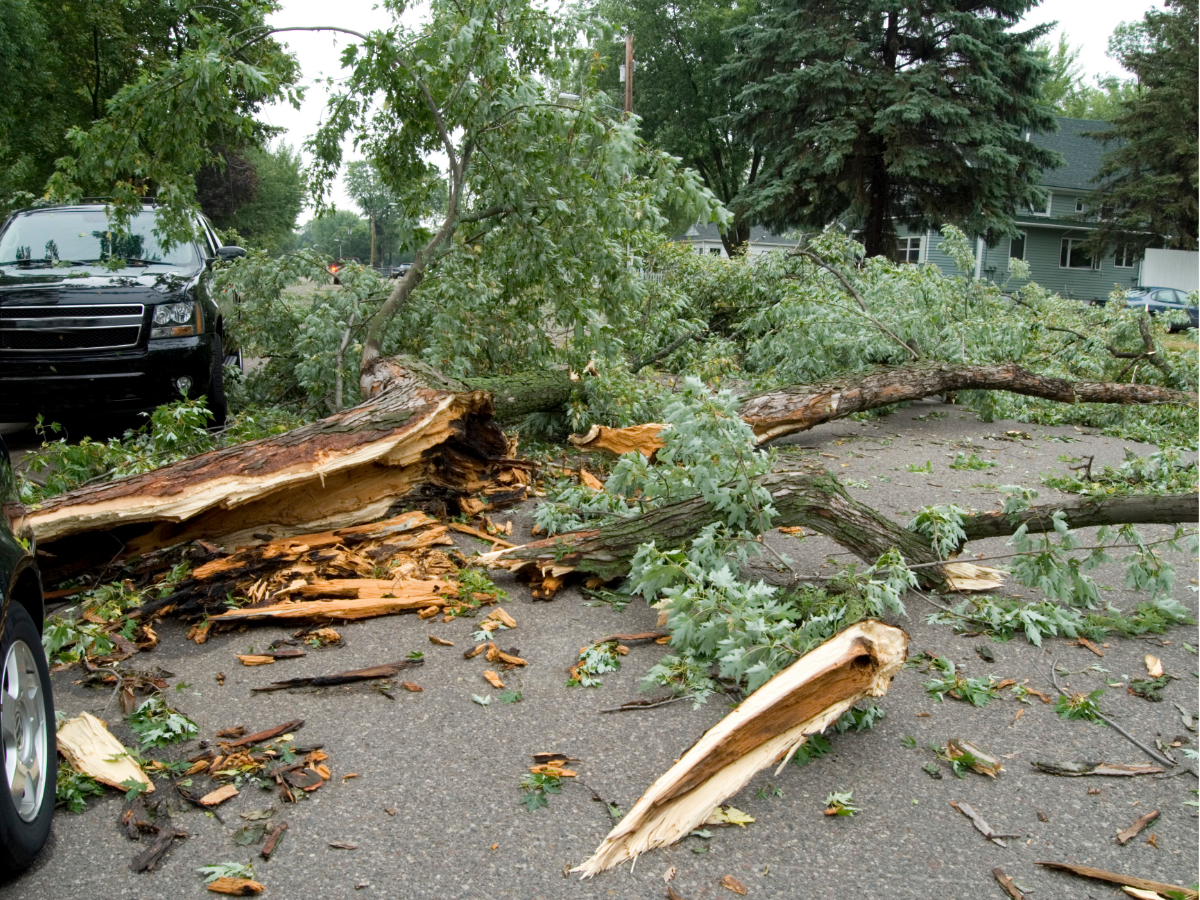
One of the most serious red flags is a split that travels completely through the trunk from one side to the other. When a trunk is essentially divided into two separate sections, the mechanical connection holding those sections together may be so compromised that any additional stress, whether from wind, the weight of the canopy, or even its own gravity, could cause the tree to fail catastrophically.
Decay is another major concern. If you notice soft, spongy wood inside or around the split, discoloration of the wood that suggests rot, or the presence of fungal growth anywhere on the trunk or at the base of the tree, those are signs of internal decay that significantly weakens the remaining wood. Fungi such as bracket fungi, shelf mushrooms, or conks growing on or near a split are particularly alarming because they indicate that decay organisms have already established themselves deep within the tree's tissue.
A tree that is leaning noticeably toward a structure, a vehicle, a fence, or a power line after sustaining a trunk split is a serious liability. Even a small degree of lean combined with a compromised trunk can create conditions for a sudden and unpredictable failure. Fall storms on Long Island are common enough that leaving a leaning, split tree in place through the season is a risk many homeowners simply cannot afford to take.
Additional red flags to watch for include:
- A crack that visibly opens wider during windy conditions or when you apply any pressure to the trunk
- Cracking or popping sounds coming from the tree
- Bark that is peeling away in large sheets around the split
- Dead branches or significant canopy dieback concentrated on one side of the tree
- Heaving or cracked soil around the base, which can indicate root failure
- A hollow sound when you knock firmly on the trunk near the split
- The split is located at the base of the trunk or at the root collar, where structural integrity is most critical
When any combination of these warning signs is present, the time for a wait-and-see approach has passed. A professional assessment should happen as quickly as possible, and in many cases, emergency tree removal becomes the safest option for protecting your property and the people around it.
Why Fall Is a Critical Time to Assess Split Trees on Long Island
Homeowners sometimes assume that fall is a good time to hold off on tree work because trees are going dormant and the season feels quieter than summer. In reality, fall creates a specific set of conditions that make damaged trees more dangerous, not less.
As deciduous trees shed their leaves, the visual cues that help homeowners identify problems during the growing season begin to disappear. Wilting leaves, sparse canopies, and unusual discoloration are all easier to spot in summer than in late fall when bare branches all look similar. This means that going into winter without having your split trees assessed means entering the most storm-intensive months with unknowns still unaddressed.
Soil moisture also plays a role. Fall rains saturate the ground, which can loosen root systems and reduce the anchoring strength of trees that are already structurally compromised. A split trunk that seemed to be holding its own during a dry summer may become suddenly unstable once the soil around its roots becomes saturated.
Wind events on Long Island tend to increase in intensity as the season progresses. Even without a named storm, nor'easters and fast-moving cold fronts can generate sustained winds and gusts that place enormous stress on compromised trees. The combination of wet soil and high winds is one of the most reliable predictors of tree failure, and a split trunk is already starting from a position of weakness.
Taking the time now to have your trees professionally assessed means you are making decisions before a crisis, rather than scrambling for help in the middle of a storm. That is always the better position to be in.
When to Call a Professional and What to Expect
Even if you feel reasonably confident reading the visual indicators described in this guide, there is no substitute for a trained eye when it comes to tree safety. A certified arborist or experienced tree service professional has the knowledge, the tools, and the vantage points to assess structural conditions that simply are not visible from a ground-level walk around your yard.
Professional tree inspectors can probe split areas to assess the depth and extent of decay, evaluate the angle and direction of the split relative to the trunk's load-bearing axis, assess the root zone for signs of failure, and determine whether cabling or bracing might be a viable option for preserving certain trees. Not every split trunk needs to come down, and a professional inspection can help you understand your options clearly rather than making decisions out of fear or uncertainty.
That said, when removal is the right answer, it is important to work with a team that is equipped to handle the job safely and efficiently. Split trees are unpredictable, and removing one requires careful planning to avoid secondary damage to surrounding structures, utilities, and landscaping.
If you are in the Lindenhurst area or anywhere across Suffolk County and you have a split tree on your property that is causing concern, the team at Joe Tree Tree Service is available 24 hours a day, 7 days a week for emergency tree removal situations involving fallen and split trees. Do not wait until the situation becomes a crisis. Reach out to Joe Tree Tree Service at (631) 956-3740 or visit them at 515 Venetian Blvd, Lindenhurst, NY 11757 to get a professional assessment before the next storm rolls through. When a split tree is putting your property or your family at risk, fast and informed action is always the right move.
Search
Recent Post


LET'S CONNECT
Expert Lawn Care. Friendly Service.
Need reliable tree services on Long Island? Our experienced team is ready to help with safe, professional tree removal and more. Contact us today for a free estimate!
Call us now: